Verse-by-Verse KJV Commentary
Proverbs 14:10-13
Joy, Sorrow, and the Way That Seems Right
10 The heart knoweth his own bitterness; and a stranger doth not intermeddle with his joy.
Proverbs 14:10 KJVEvery human heart is finally a private room. Your deepest bitterness cannot be fully told even to the dearest friend, and your deepest joy cannot be fully shared — there is a pilgrim's load that must lie on your soul alone, a grief no one else can carry an ounce of. Even marriage has no line long enough to sound the bottom of that solitude. But there is One who enters the locked room: the Lord Jesus, who said "Saul, Saul, why persecutest thou me?" — feeling another's wound as His own. Only Christ's sympathy is real and complete; He walks with you through the valley where no one else can follow (Psalm 23:4).
11 The house of the wicked shall be overthrown: but the tabernacle of the upright shall flourish.
Proverbs 14:11 KJVNotice the swap. The wicked man has a solid house — and it gets overthrown. The upright man has a flimsy tent — and it flourishes, blossoms, puts out shoots like a living plant. The strongest support a man can build for himself eventually totters; the support God gives the weakest believer is Omnipotence. A poor mud-walled cottage with God in it is incomparably better than a mansion built without Him.
12 There is a way which seemeth right unto a man, but the end thereof are the ways of death.
Proverbs 14:12 KJVHere is the verse the whole chapter circles, and it must be read slowly, because it is the most dangerous spiritual condition described in Scripture: a road that seems right — feels right, looks right, is sincerely believed to be right — and ends in death. Sin's most fearful property is its power to hide its own character, so that a man can be on the broad road to ruin and feel perfectly safe. The most moral, unconverted, church-attending man can still be the slave of sin and not know it.
Watch the false roads men sincerely walk. There is the sober worldling, decent and respectable, who thinks of God's law as if it had only one table — kindness to neighbors — while ignoring the first table altogether, and who goes down to the grave with a lie in his right hand. There is the formalist, busy with religious services that have no life in them, and so cannot end in life. There is the religious speculator, full of correct opinions — but speculative opinion is not saving knowledge. And there is the self-righteous man, who is all three at once: the Pharisee, certain he is bound for heaven on a road that dead-ends in death. What do they all lack? The cross. The way to heaven — the way of life — is measured from Calvary; from the foot of the cross alone can any sinner set out on it.
And do not think sincerity excuses the error. A captain may sincerely believe he is in the safe channel — will the rocks spare his ship because he was sure? It is not a clearer head that is needed, but a softer heart, willing to be told it is on the wrong road. The verse has a bright twin that the gospel supplies: there is a way which is right, and the end thereof is life — and that way is a Person: "I am the way, the truth, and the life" (John 14:6). Check your road against Him, not against your confidence.
13 Even in laughter the heart is sorrowful; and the end of that mirth is heaviness.
Proverbs 14:13 KJVThe world's laughter is often a thin lid on a troubled heart — many a sigh is heaved in the middle of loud merriment, and the party ends in heaviness. The fool courts laughter precisely to drown out the inner monitor, to silence conviction for one more night. But sorrow is the standing condition of a fallen world, and noise does not cure it. Mark the contrast: the ungodly are first merry and then mournful — they sing and then they sorrow — while the believer is first weary and then merry, the grief now and the gladness without end. It is far easier to drown conviction than to escape damnation.
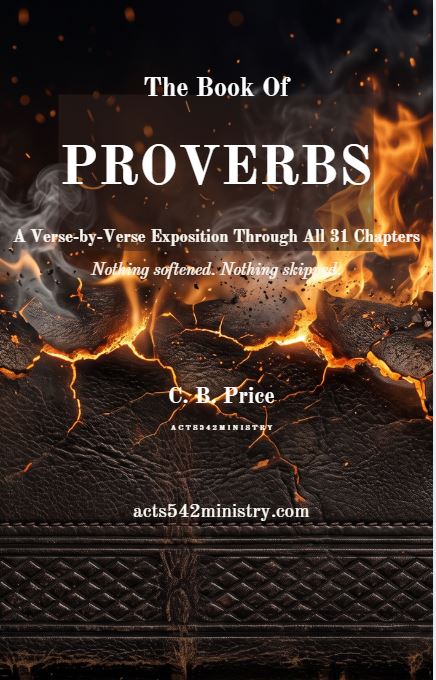
The Full Commentary
Proverbs: Wisdom from the KING
All thirty-one chapters, verse by verse, in plain language — 407 pages, King James Bible only. These pages are a sample; the book is the whole of it.
See the Book →