Verse-by-Verse KJV Commentary
Proverbs 28:12-20
Public Fortunes, Confession, and Saving Fear
12 When righteous men do rejoice, there is great glory: but when the wicked rise, a man is hidden.
Proverbs 28:12 KJVWhen good men flourish and are lifted up, a whole society feels the blessing and there is "great glory"; but when the wicked come to power, honest people are driven into corners, silenced, hidden away — as Elijah hid in the cave. Yet they are hidden only to the eye of sense; God knows where His Obadiahs are, and the world is not worthy of them.
13 He that covereth his sins shall not prosper: but whoso confesseth and forsaketh them shall have mercy.
Proverbs 28:13 KJVHere is the gospel peak of the chapter, and one of the clearest verses in all of Scripture on how a guilty sinner finds mercy. Notice first the contrast it does not draw: it is not between big sins and little sins, but between sins covered and sins confessed and forsaken. Cover your sin — deny it, excuse it, minimize it, hide it behind a fair appearance — and you "shall not prosper," for covering it shuts the door on the cure. Picture a great iron beam with a smooth, perfect skin over hidden air-pockets inside the casting: it looks sound, and it gives way the instant any real weight comes on it. That is a covered sin, and the weight that will find it out is the judgment of God. The only road to mercy runs the other way: confess and forsake.
But hold two things together precisely, or you will wreck this verse. First, it must be both — confession and forsaking; not a mumbled admission that changes nothing, but an acknowledging that turns and walks away from the sin, the hearty forsaking being the best proof that the confession was sincere. Pardon never follows confession that is not accompanied by new obedience. Second — and this is everything — do not make your confessing and forsaking the thing that earns the mercy. God does not need your confession for information, and it lays no claim on Him; it is not the price of mercy but the meetness for receiving it. Get the order right, the way the gospel does: mercy comes first. It is the promise of life that makes the dying man open his gates; it was God's mercy, shown in Christ, that first broke and softened your hard heart so that it could confess at all. So you do not confess in order to be loved; you confess because you have seen the cross and been overcome by a love already offered. "If we confess our sins, he is faithful and just to forgive us our sins" (1 John 1:9) — and the faithfulness and justice both rest on Calvary, where the price was paid. So do not plead the smallness of your sin; plead its greatness, and bring it all out into the light, for the way to cover your sins forever is to uncover them now. No one was ever shut out of heaven for his confessed badness; multitudes are shut out for their supposed goodness.
14 Happy is the man that feareth alway: but he that hardeneth his heart shall fall into mischief.
Proverbs 28:14 KJVNow read this carefully, because it sounds backwards: happy is the man who fears — always. But this is no slavish dread; it is reverent, watchful, holy fear, the fear of a child who would rather die than grieve his Father, and it walks hand in hand with faith. In fact, here is the rule to live by: faith without fear is just self-confidence and self-delusion — so instead of being afraid to mix faith and fear, dread their separation. The man who keeps this tender fear is happy and safe; the man who hardens his heart — who silences the fear, stiffens his neck against the Word, presumes — is heading for a fall (as Pharaoh hardened, and even Peter, presuming, fell). Live in a holy dread of yourself, and a glad confidence in your God.
15 As a roaring lion, and a ranging bear; so is a wicked ruler over the poor people.
Proverbs 28:15 KJVA wicked man set in power over helpless people is as terrifying as a roaring lion or a hungry, prowling bear — no pity softens him, and resistance only rouses his fury. Scripture could not find more dreadful images, and it uses them deliberately: tyranny over the defenseless is bestial, and God sees every clawing of it.
16 The prince that wanteth understanding is also a great oppressor: but he that hateth covetousness shall prolong his days.
Proverbs 28:16 KJVOppression is, at bottom, stupidity — a ruler who grinds his people lacks the understanding to see that his true wealth lies in their trust and goodwill; he plunders his own treasury. The ruler who hates greed and refuses to exploit reigns long and securely, his throne built in the hearts of his people. (And for the believer the principle holds even of the harm done to him: what would crush a weak man only builds up the strength of a saint — "that which mischief meant most harm shall, in the happy trial, prove most glory.")
17 A man that doeth violence to the blood of any person shall flee to the pit; let no man stay him.
Proverbs 28:17 KJVThe murderer flees, hunted by his guilt, until the grave finally receives him — and "let no man stay him" means: do not shield a man of blood from the justice he is fleeing. The principle reaches back before Sinai to the covenant with Noah, "whoso sheddeth man's blood, by man shall his blood be shed" (Genesis 9:6) — of universal and abiding obligation, and a sentimentality that would be "more pitiful than God" is no kindness. Grace cannot take the place of justice until justice has first been honored — which is exactly why the cross had to happen: there justice was fully satisfied so that mercy could flow freely. And it remains a joy beyond words to bring even the man under the law's sentence the free forgiveness of the gospel.
18 Whoso walketh uprightly shall be saved: but he that is perverse in his ways shall fall at once.
Proverbs 28:18 KJVThe man who walks a single, upright road — walking before God, seeing Him who is invisible — "shall be saved." The man with two crooked ways, trying to serve God and Mammon at once, "shall fall at once" — and it will not matter which way he falls, because the double-minded osier that bends with every wind snaps in the first real storm and does not rise again. Walk one way, the upright way, and even there cry, "Redeem me, and be merciful unto me" (Psalm 26:11).
19 He that tilleth his land shall have plenty of bread: but he that followeth after vain persons shall have poverty enough.
Proverbs 28:19 KJVWork your own ground and you will eat; chase empty people and empty schemes and you will have poverty in abundance. The bread comes not by miracle to reward laziness but in the honest use of means — God does not rain down manna on the idle. Idleness is a sin against God, against your neighbor, and against yourself; and the same law runs in the soul: he that tills his soul gets a return for every stroke.
20 A faithful man shall abound with blessings: but he that maketh haste to be rich shall not be innocent.
Proverbs 28:20 KJVA faithful, dependable man is showered with blessings on every side; but the man in a feverish hurry to get rich "shall not be innocent" — the haste itself breeds guilt, because greed will hurry a man right over the belly of his own conscience into sin. The contrast is not faithful-versus-rich, but faithful-versus-grasping: the godly man would rather be poor by Providence than rich by sin, because for the impatient soul God's promise simply does not run fast enough.
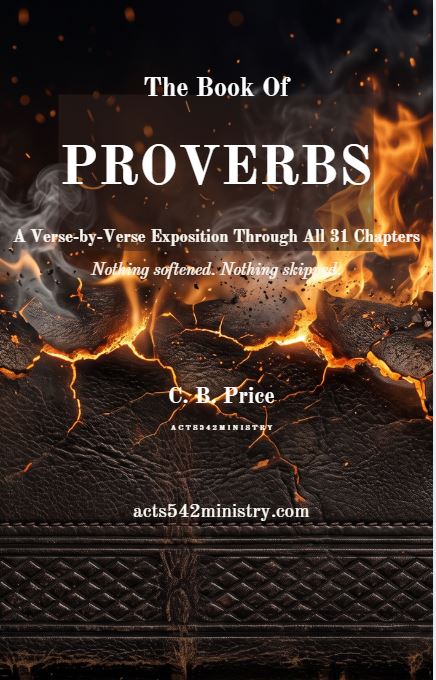
The Full Commentary
Proverbs: Wisdom from the KING
All thirty-one chapters, verse by verse, in plain language — 407 pages, King James Bible only. These pages are a sample; the book is the whole of it.
See the Book →